









Technology lust?
May 24th, 2006For over seven years we worked creating digital montages for architecture offices in order for them to convey what they are doing to clients, councils and courts. For better or worse we were pretty damn good at it and could create montages that looked like photographs. We knew all the tricks and developed some of our own that would fool the observer into believing that what they were looking at was actually a real photograph.
Eventually the desire to create digital photographic compositions lost its challenge and for some time basically lost all interest in doing it. Part of this came from the fact that as years went on the software used to create such images became better and better and eventually any monkey with a ‘dim sum’ PC and a hacked version of some 3D app could create pretty realistic images. Having been pro’s in the ‘biz’ we can pick a good image from a bad one at a quick glance. It seems though for many others, a half arsed image that sort of does the job is enough, especially when it comes at a bargain basement price. Back aches, square eyes and clients that never pay deserves some compensation. Working for bargain basement prices is not all that enticing, especially when it’s a nice day outside. With that market shattered by cheap operators, the other market that is still strong is for the creation of what’s called ‘hyper real’ images, 3D images that look like the real thing.
We’ll will concede that this sort of imaging has changed the world in which we live. Movies would not be the same without the use of hyper real 3DFX and professions such as product design have been revolutionised through the use of 3D visuals and design studies. A lot of the work we do demands 3D images to present a clear picture t our clients. What we question is the desire to use it to create, ummm, well, images as art.
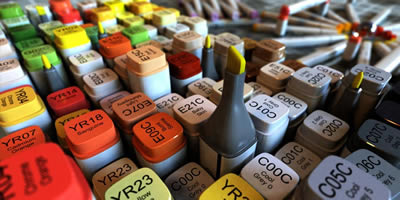
The above image is a good example of this, created by Le Richard Minh, an RMIT architecture student. He created this image because “It reflects much of my vision towards art.” We are sure it took him many hours to do it, as creating this sort of digital image is very time intensive - from the need to scan in graphics to place on the 3D models as ‘maps’, to the time spent in modeling and setting up the composition and lighting. Even though the 3D application will do a lot of the really hard work, unlike 10 years ago, the time taken to create this piece would not have been insignificant.
The question we pose is this: The image is so realistic, what’s the point of creating this in a computer as opposed to setting it up in the real world and taking some photographs? With Photoshop manipulation the outcome would be pretty much the same. Is this sort of thing a case of the lust of technology overpowering the simple facts that doing it the old fashioned way would not only yield the same result but might also be faster, more cost effective and even possibly more interesting?










