Our Materials
About
In the heat
In the cold
Strength + Durability
Real world testing
Threads
Zips
Our Merino
Merino science
The choice to use the best materials is fundamental to Lab-Gear’s products. It’s one of the things that helps us feel great about what we make and means our products out-perform others and stand out from the crowd.
We’ve done a solid amount of testing to make sure what we put into our products works. And most of the time the best results come from nature.
Overall, we love Merino. We found polyester textiles held smell, developing long term smell ‘memories’, and often had durability issues due to their perforated weave. While the very best polyester woven’s do possess great wick characteristics pulling moisture away from the skin (unlike chemically treated polyesters where the solution washes out), they don’t make you any cooler in the heat. More interestingly though is that we found they don’t keep you anywhere near as warm in the cold compared to natural Merino textiles. So, for a year-round solution, polyester textiles are far less versatile than natural Merino options. There’s just something about a sheep that is smarter than the best mankind can come up with when it comes to making superior textiles!
In the last decade of dealing with all sorts of materials from all sorts of suppliers, and testing it in all sorts of applications – from mountain biking, snow sports and everyday living – this is what we’ve found…
[top]
In the heat:
If it’s stinking hot, nothing will make you cooler, or keep you dryer, other than wearing less. We’ve worn the best man-made fibres, cottons and Merino in +36 degrees C (+90 degrees F) and found that none performs better than the other. We got hot, sweated and that was the end of it. So if you’re going to wear something you may as well make it natural and keep the smell factor at a minimum.
[top]
In the cold:
While the very best polyester-based textiles can wick moisture away from the skin, aiding you in staying warm (by keeping you dry), if they become saturated you will get, and stay, cold.
Cottons don’t work as a warming, thermal layer. They tend to hold moisture in the cold, robbing you of vital body heat as the moisture cools your skin.
While Merino does not wick as effectively as the very best woven polyester fibres, it helps to keep you warm no matter how wet you get by regulating body heat through the nature of the fibre itself (please see the technical rundown below). With effective layering, we found Merino is superior to other materials in the cold and is far more durable than the delicate performance man-mades, making it much more versatile for year-round use.
[top]
Brute strength and durability:
1000 Denier Ballistic Nylons and Cordura are insanely strong and durable, which is why in some applications we’ll still use them. When it comes to sheer value and flexibility, 100% cotton drills are great for pants all year round (the military’s of the world are not all mad) and leather is the undisputed legend when it comes to carry goods (plus there’s nothing better to touch or smell than a good leather!). Again, while man-made, oil-based products can be good, nature provides us with solutions that are every bit as good and in some cases better, are far more flexible and don’t rely on oil for their creation.
[top]
Testing our materials:
How do we make sure that the materials we choose are up to the task? Simply put, we wear it until it dies.
For example:
We made a set of jerseys for Sydney’s bike messenger set from our 165gsm Superfine Merino, and then stayed in contact with our main man ‘B-Rad’ to see how they held up.
As an example, one jersey was worn for 3 days a week (30+ hours in total every week), in all conditions. It was hand washed every night and hung dry. Every day it suffered having a fully loaded courier bag rubbed against it and its pockets were loaded with a heavy digital order processor and various other items of ‘stuff’.
The jersey lasted through this abuse for 11 months before a hole wore through the back of it where the bag strap constantly rubbed against a contact pressure point. The rest of the jersey is fine and is still used as a second layer under other items.
In comparison, B-Rad’s official work jersey, a typical polyester, ‘made in China’ number, has around the same material wear rate (it holds up to a comparative level of abuse before holes appear in the material), but the overall jersey has performed less well, with the hems and stitching starting to come undone in less than six months.
That to us is real-life testing!
[top]
Threads, zips etc:
As Lab-Gear developed and we’ve learned about our products and our craft over the years, our standards have become increasingly higher. We make our kit locally and pay (what is considered in the rag trade) top dollar for our sewing. To ensure maximum quality and durability to match the high standard of our materials, we use the best ‘haberdashery’ to put our garments together:

Threads:
To many out there in the ‘biz’ thread is just something they use to hold fabric together, therefore, cheapest is best. We could not disagree more. The quality of the thread used to sew a garment is part of the big three ‘essential elements’ (fabric, fit, construction). For overlocking we use a top quality Australian thread, and for top-stitching we generally use Rasant threads (from Germany), regarded widely as one of the best threads available. This ensures that the thread is not only good to use at the sewing stage, minimising breakages mid stitch (which means cleaner finishing), but it’s also super durable and colour-fast for the long term.

Rasant also is certified according to the Oeko-tex Standard 100 for textiles tested for harmful substances.
[top]
Zips:
Our new lines of garments now feature Riri zips. After several years of on-and-off searching for a local supplier, we are proud to say that we are now able to use Swiss (and sometimes Italian) made Riri zips, renowned as the best zip in the world. While cost-wise they are around a 4:1 ratio when compared to Chinese made counterparts, their streamlined mechanism and durability mean they are without doubt the best zip one can use – so are worth the extra investment.
From Riri:
“Founded in 1936, Riri is one of the oldest industrial manufacturers of zippers. Since inception, Riri products have gained worldwide acceptance and recognition as the ultimate in quality, precision and reliability adding value and distinction to the products to which they are applied. In many top-of-the-line items such as fashion clothing, luggage and handbags, Riri zippers are what discriminating clients recognize as a symbol of quality.”
“Martin Othmar Winterhalter, Riri founder, coined the name Riri in 1923 as an acronym of Rille and Rippe, the German terms for concave and convex that comprise the shape of zipper teeth.”
[top]
Merino:
The Merino textiles we use are sourced from local producers which adhere to stringent manufacturing regulations to ensure a sustainable product, made with low impact on the environment.
Our fabric uses only the purest and highest grade fibre and is woven into fabric in Australia and New Zealand.
A quick rundown on our main Merino materials:
165gsm + 270gsm single jersey Merino:
This is the workhorse of our range. Light and tough, yet super-soft against the skin. The 165 regulated body temperature so well we recommend it as a base layer in cold climates and as an only layer in warm climates. We have personally tested the fabric from 0 degrees C all the way through to 38 degrees and can vouch for its outstanding qualities.
320gsm Ponti di Roma:
Used in our mid-weight layers, the ‘Ponti’ is a heavy yet non-bulky fabric (due to a tight weave) that makes for an ideal outer layer when combined with the 165 in cold weather, as a single layer in spring/autumn, or as a layer to wear under a shell in appalling weather!
We have selected the fabrics based on their outstanding performance when used in both highly active pursuits as well as more sedate pastimes like the ’9-5′ or visits to the pub.
[top]
For those that like something juicy to read, here’s some tech on Superfine Merino:
FIBRE STRUCTURE AND CRIMP
A wool fibre is a complex structure. It is predominantly made of keratin, a protein that is present in our own skin and hair. Wool fabrics behave similarly to our skin and compliment the body in maintaining homeostasis in normal and extreme climatic conditions.
The interlocking protein molecules within individual fibres gives its structure strength and resilience; it can be bent, flexed, and stretched in any direction 30,000 times or more without damage.
Wool fibres have a natural curl called the “fibre crimp” which improves the elasticity of the fibre.
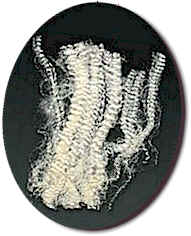
The fibre crimp is easily observed in raw wool
Furthermore, it promotes entrapment of air between the wool fibres which acts as an insulator against both hot and cold temperatures. The fibre crimp of the wool aids in the construction of technical performance fabrics that exhibit exceptional “condition buffering” abilities.
Every wool fibre is constructed from a unique series of proteins. A typical protein structure is illustrated here, however the nature of wool is so complex that science is yet to map its configuration entirely.
WOOL’S HYGROSCOPIC ABILITY
Wool is an active fibre that has hygroscopic characteristics allowing it to absorb and release moisture from the air. Fibres respond continuously to the moisture content of the surrounding air and will absorb or release moisture to maintain an equilibrium with their environment. The wool fibre is only able to absorb and release moisture when it is in a gaseous form, such as vapour. The hygroscopic ability of the fibres within woollen fabrics gives the fabric with the intrinsic ability to move moisture from one environment to another. The movement of moisture through wool fabric applied to the body is governed by the difference in the moisture content of the microclimate, the area between the skin and the fibre, and that of the external surroundings. As the atmosphere will always contain some moisture unless artificially modified , so too will the wool fibre. Under normal atmospheric conditions the wool fibre will retain 14% to 18% of its own weight in moisture. However, the amount of moisture within the fibre at any one time is directly proportional to the relative humidity of the surrounding air. A wool fibre can absorb and release up to 35% of its own weight in moisture while staying dry to touch.
MOISTURE VAPOUR ABSORBENCY
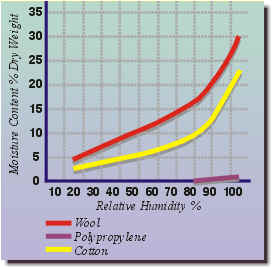
Wool has a natural ability to hold moisture vapour within and between the fibres whereas synthetics will only hold liquid either within OR between the fibres. A synthetic product that is designed to hold moisture within the fibre is acting in the same manner as a sponge and as such has no ability to release the liquid unless it is physically forced to do so.
THE HEAT OF SORPTION RESPONSE
When water molecules are absorbed by wool fibres they attach to specific sites within the protein structure. The resultant endothermic reaction causes a release of energy through heat. Much of this energy comes from the effective condensation of the water vapour at these sites, but part results from the weak chemical bonding of water molecules to the material structure. Heat output continues until an equilibrium is reached between the moisture in the fibre and the external environment. When water vapour leaves the fibre it takes up energy again thereby removing heat. Consequently moisture absorption by fibres when the humidity rises causes the fibre temperature to rise, and moisture release following a decrease in humidity lowers the fibre temperature.
HEAT GENERATION THROUGH SATURATION
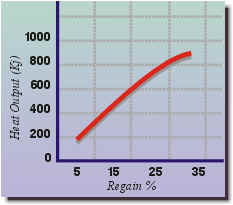
Heat generated through the endothermic reaction is directly proportional to the dryness of the garment at the time of exposure to the moist environment.
Fabric Qualities:
DURABLE
The interlocking protein molecules within the individual wool fibres have the power to elongate, stretch and recover. The resilience of wool to degradation creates an extremely strong and robust fabric that will survive years of use and abuse.
EASY CARE INSTRUCTIONS
Wool used has been “super-wash” treated, a process that modifies the outer surface of the wool fibre and allows neighbouring fibres to slide over one another. This prevents the interlocking or catching of the cuticles which causes the fibres to matt (or felt) together. This process does not affect any of the fibre performance features within the fabrics, it does make all garments made from Merino fabrics completely easy care.
STATIC RESISTANCE
Wools ability to retain moisture is also responsible for its static resistance. The retention of moisture within the fibre prevents a build-up of static electricity. This quality stops Merino fabrics from clinging uncomfortably and is especially important in safety areas where it is necessary to prevent sparking.
PILLING
Pilling is the formation of small fibre balls on the surface of the fabric; the formation of balls is caused by fibres breaking and working themselves out of the fabrics. A badly pilled fabric will reduce durability, performance and decrease it’s aesthetic appearance. The same treatment that allows Merino fabrics to be machine washed and tumble dried also helps the fabric to resist pilling.
QUICK DRYING
Given a similar fabric construction, wool will dry as fast as synthetic fabrics. Drying times of fabrics are controlled by the amount of liquid moisture held between the fibre matrix when the fabric starts its drying process, generally the thicker the fabric the more moisture it is able to retain and the longer it takes to dry. The surrounding atmosphere will then influence how long it takes for the moisture to be removed from the fabric matrix.
RESISTS DIRT
Dirt is kept from penetrating the surface of the wool fibre by the crimp and the scales. Its static resistance also helps to resist dust and lint from the air.
FIRE RESISTANCE
Wool is naturally flame retardant. A fabric made purely from wool is difficult to ignite, burns slowly, and has limited ability to sustain a flame. Burning wool fabrics are easily extinguished and the residue does not pose a severe burn hazard.
SPRAY PROTECTION
Merino fabrics provide protection when caught in a light shower of rain, or when exposed to water spray while boating or fishing. The wool fibre is primarily constructed of keratin, the same protein that makes up our skin. Wools natural spray protection is similar to our skins, it is able to repel water from its surface and transpire moisture vapour.
UV PROTECTION
Merino fibre offers high natural UV protection compared to many other fibres including cotton.
(Study by Gambichler, Rotterdam, Altmeyer and Hoffman, 2001).
COMFORTABLE / BODY CONFORMING
The diameter of the wool fibres used in the construction of a fabric will determine the degree of “itch” it will provoke. Broader fibres have less ability to bend or give which results in a prick when pressed against the skin. This pricking sensation creates the “itch” that some people may experience when wearing wool clothing. The characteristic “itch” factor of wool fabrics is overcome by our Merino through selection of superior fine merino fibres which have the ability to bend or give when pressed against the skin. Due to the elastic nature of the wool fibre, our Merino fabrics are able to conform to and follow the shape of the body. This enhances garment performance, wearer comfort, gives freedom of movement and assists the processes involved in micro-climate control by holding the fabric close to the skin.
[Information on superfine merino provided by iZ Wool International P/L.]
[top]