


Topics
- Analogue
- Bike: Awaba MTB Park
- Bike: Biz
- Bike: Design
- Bike: Gear Reviews
- Bike: Life
- Bike: MTB Advocacy
- dp[r]m
- Flotsam: Brain Farts
- Flotsam: Design Culture
- Lab-Gear: Two6Racing
- Lab-Gear: Workshop
- Moto
- Retrospective
- Reviews of…stuff
- Stuff that needs sorting
- Video


 :Designing a Mountain Bike
January 16th, 2012 | No Comments » |
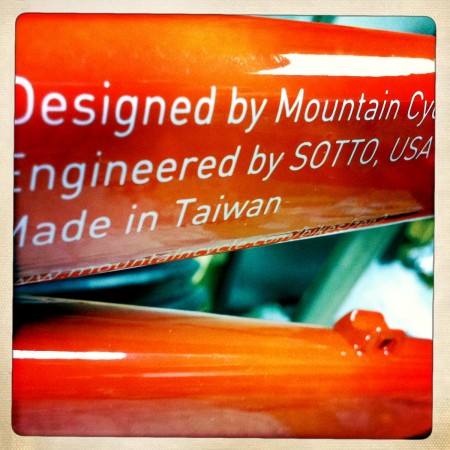
Done and dusted with Mountain Cycle, I was cleaning up my files when I came across a wad of drawing scans I did that defines the design process of the Mountain Cycle San Andreas 2.0; from the period of 2008-2011 I was involved with Mountain Cycle and in 2009 was tasked to design, manage and oversee (the Taiwan based owners chose to manage production and QC themselves) the first new line of frames the company had seen for some years.
The design process used to create such bikes, or products for that matter, is one that for many remains a mystery - it’s understood that somewhere someone does something and at the end a finished product is spat out of a factory but not much more. So rather than bury this away, never to be seen again, I thought some out there might find the whole process interesting, or at very least slightly entertaining.
Industrial Design is the design of, no, not industry but products. The more suitable name for the profession is ‘Product Design’ and for better or worse, it plays a central role in everyone’s everyday life, at least in the developed world. From the spoon you ate your cereal with, to the car (!) that drove you to work and the computer that you are reading this on, a Product Designer has spent more than a few hours to conceive, design and develop the numerous products you have interfaced with so far today. In the world of bicycles, for those companies that invest in design beyond the traditional, it’s no different.
It all starts with a brief.
The brief is completely dependent on the aims of the company and what it’s end goals are for the project in question. In some cases it may be as simple as designing something to fit a certain price point or market, to fill a gap in their line, or it could be far more in depth, tying in all manner of different factors to create what are called ‘masthead products’. For Mountain Cycle, designing the San Andreas 2.0 was to take the bull by the horns and design a bike that not only took on the namesake of it’s legendary predecessor, but which was also the masthead of the company. It was no small task considering the legendary status of the original and I knew no matter what we did, it was going to offend someone somewhere - as is usually the case in such projects where the core customers are emotionally attached to the original design.

2001, The original
The concept. An idea derived from the base criteria.
Even before I begun, I knew that the design was going to be a single pivot (SP). Not only was SP a mainstay of pretty much all previous Mountain Cycle frames but it’s also something I firmly believe is the ideal system for people that ride hard, a lot - it’s simple, effective and easy to maintain (read my thoughts on this here). With this in mind though, I also wanted to introduce a rocker into the system to fine tune the shock’s travel path and ultimately make it more suitable to an air shock.
Lastly, I always thought for an aluminium frame, the BB, swingarm and rocker pivots should all be part of the same central assembly to ensure good long term alignment and stiffness and with these key criteria in place, a rough ‘package’ of datum points was established to start working around as the basis for the design concept.

Early Concept sketch
The simultaneous greatness and failing of the original San Andreas was the Monocoque frame. Failing because monocoque frames generally suffer from a ‘one size fits all’ syndrome, either that or you require tooling for each and every size, tooling which becomes very costly to establish and a real issue to modify or update (pretty much like carbon frames). Add to this, the subframe sizing/multi-position solution employed by the original to work around the single size mainframe really was a little half arsed - nice in theory, not so great in practice as it repositioned the COG (center of gravity) differently on the same wheelbase.
For the new San Andreas, a more traditional arrangement needed to be employed, one that would allow for a relatively easy resizing of the frames while eliminating the need to modify the base tooling. This of course would not be in keeping with the gist of the original and while I knew we would put noses out of joint and offend people, the realities of modern Asian based volume production had to be allowed for - there is little room, or (often) interest, for flexibility or doing things out of the ordinary.
The most logical conclusion was to use a down tube (DT) and then create the feeling of the original monocoque and subframe, elements that defined the San Andreas, via a Top Tube (TT) arrangement - but one that could be trimmed to size. Doing this would be creating something that both took the San Andreas forward but also showed a lineage from the original.
Many have said that this style of design is closer to the older Mountain Cycle Fury of the early 2000′s, but interestingly a little known fact was that the ‘Fury’ frame was devised as a cheaper, easier to produce, San Andreas; I always have felt that the Fury should have been called something closer to San Andreas, SA 1.5 maybe, rather than Fury, making the continuation of the marquee over time easier. Looking at the Fury frame, one also realises that as a design it’s rather efficient so designing something in the way that was being looked at, but NOT be a new Fury, was not an easy ask.
Once the idea of a monocoque style ‘TT’ was settled on, the job was to design and define the form of the tube itself, as this was going to become the focus of the frame. By this stage, Sotto Group was involved to provide an engineering and suspension solution, so trading back and forth, we came up with the concept of passing the shock though the ‘TT’ via what became known as the ‘Shock Tunnel’. Doing this allowed a form to be created that was smooth and seamless, not broken or forced forward as would have been the case if the ‘TT’ were to be interrupted, or not, by the shock.
Having Sotto on board also meant we could employ a SP suspension system they had been working on that perfectly matched what I had originally been thinking about; but took the concept to the next level. The ‘Turntable’ system, as it came to be known, fine tunes the shock path and rate through a rocker that revolves around a patent pivot system. The net result of this was each bike designed to use the Turntable system could be fine tuned to achieve maximum effectiveness from the suspension, all the while being anchored in a central ‘block’ as I had envisaged.
With the core foundations now set in place, over a period of a month or so, the design and development of the frame took shape.

Click image for gallery
As can be seen, the original designs for the TT were a lot more ‘crisp’ with a far more developed aesthetic. The original design would have seen the whole ‘TT’ formed as a single piece through hydraulic pressure forming, also known as ‘hydroforming’. Unfortunately, the owners of Mountain Cycle ultimately chose not to make the spend on the initial tooling cost to create the hydroforming dies for budget reasons, so we elected to making the tube through the more basic monocoquue process of pressing two half shells and welding down the centre - the same way the original frame was made 20 years earlier. The cost savings using this method ultimately were marginal, as the increased amount of time required to set up the initial moulds, increased labour content, complex welding jigs, seam welding and resulting defect rate ultimately would outweigh the initial tooling investment of hydroforming over the medium to long term.
It was in moving to the monocoque process, that much of the ‘crisp’ detailing was lost from the tube; the pressing methods utilised to create the half shells are unable to achieve the finer level of detailing able to be gained through hydroforming. As a result, the final design ended up being much softer than originally conceived.
Once the from and overall mechanics had been decided and agreed on, Sotto built the frame in 3D via software called ProEngineer. As Sotto was to work directly with the factory in Taiwan for the pilot run process and the initial tooling set up etc., they undertook all the 3D work, something quite often undertaken by the Product Designer who then passes over to the engineer to refine and engineer further. Finally, once the frame was fully realised in 3D, we could assess the design more comprehensively and make alterations and amendments as needed.

Click image for gallery
After the final round of refinements were translated back into 3D and everyone was happy, the process began to tool up for prototyping and initial production.

Click image for gallery
While several steps both Sotto and myself deemed essential prior to actually starting on tooling and production starting were skipped, and as I had made the call to CNC all of the required parts for the initial runs (as opposed to going straight into costly and time intensive forging tooling as the factory would have preferred), pretty much everything worked out first time around with minimal of fuss (luckily); only a few minor changes had to be made, requiring new CNC parts, not modified or even new forging tooling, which would have taken months to do.

Click image for gallery
As the design team, we knew the end result could have been better in several areas but overall we all felt the end result is pretty damn good; the aims to create a design that could sit along side the original, as its successor, were met.

Click image for gallery
Following on from the San Andreas design, I kept the to the same thinking to create a ‘family’ and we very quickly progressed to design the Zen II, a scaled back and far more traditional design and then go on to produce the Shockwave Two DH frame, a visually far more aggressive version of the San Andreas 2.0 and one intentionally at odds with the current crop of ‘swoopy’ designs. Again, the use of hydroforming to form the Shockwave TT, rather than the monocoque method, would have produced a for more refined design but the end result, all felt, produced the desired results.

Click image for gallery
Overall the designs of both the San Andreas and Shockwave frames have polarised people, in a market that I personally feel is driven by a ‘chasing one’s own tail’ mentality. I wrote an article about this some time back, so won’t repeat it here but no one on the team is unhappy with the end results. Ultimately, we all felt the new bikes represent what Mountain Cycle stands for as a brand perfectly - bulldog, industrial machines for riders first. And that’s the job of good design - to embody what a brand stands for.

Click image for gallery
Tags:design,frame,mountain bike,mountaincycle
Share the love...?
Tweet
Leave a Reply...
You must be logged in to post a comment.


